

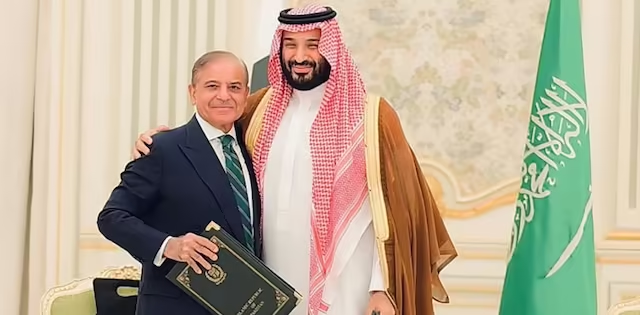
On 17 September 2025, Pakistan and Saudi Arabia signed a historic Mutual Defense Pact institutionalizing their historic alliance shaped by religion, culture and history. The alliance, as announced, purports to treat an aggression against either state as the one against both.
The Saudi officials clarified that it has been the result of a year-long negotiations between the two states. As the pact has been making headlines around the world and potentially sending alarm signals to regional powers; it is important to decode its importance, timing, and objectives that it is headed to achieve.
Timing signals message
The formal announcement has come week after Israel’s missile attack on Qatar targeting Hamas officials that jolted the Arabian states who solely rely on American guarantees for their security. As the attack on United States strong partner has shook confidence of the Arab leaders to search for alternative partners. It has also signaled American waning influence in the region.
Continuing framework of strategic partnership
While some believe this move to be radically new and alarming. It shall be seen in the historical perspective of Pak-Saudi longstanding friendship. Saudi Arab was the one of the foremost states to recognize Pakistan. Both the countries signed ‘’Treaty of Friendship” in 1951 allowing military training, exchanges and strategic sharing. Since then Pakistan has trained around 10,000 Saudi troops. In 1982, three years after the Iranian revolution, Pakistan and Saudi entered into an agreement whereby Pakistani troops would be stationed in KSA in aid of Saudi forces. In continuation of the policy, Pakistan currently maintains troop strength from 3500 to 6000 in the Kingdom. So in this way, the recently signed pact sounds more of an institutionalization of a Pak-Saudi long-term strategic relationship than a drastic move that aims to cover any specific agenda or deter global move. However, with this new move, Pak-Saudi relations will receive a renewed sense and deepen in strength.
Strategic calculations shifting to Pakistan
For Pakistan, this is another milestone in the backdrop of a recent military standoff with India. Surprisingly, Pakistan’s diplomatic successes have been phenomenal with increasing partnerships with USA, Central Asian republics, Turkey, Iran and now Saudi Arabia. This has effectively diluted the atmosphere of alienation shaped by India in the recent years by spread of propaganda. Pakistan, not only victoriously rose up from the conflict, but also has been making strides by engaging with international and regional powers as a responsible state and has won praise for its commitment to peace and stability in the region as a credible nuclear state. As the global players watch over, Pakistan significance in the area of military deterrence has re-emerged in the gulf who is now looking forward to invest in Pakistan’s defense capability for their own security needs. It is likely that after Saudi-Arabia’s reliance on Pakistan, states like Qatar, Bahrain, Oman, UAE and Jordan will follow en suite.
Show of solidarity or a rattling sword?
There has been much debate that the pact means that both nations would enter each other conflicts but it questionable whether the alliance really means that. As provided above, that the security partnership is not new between both the countries. Withstanding such arrangement the Pakistan Parliament decided not to enter Saudi-led military intervention in Yemen 2015 for its own national interests. Similarly, Riyadh did not come to aid Pakistan’s forces in the military skirmishes with India but however, it has been deepening ties with New Delhi economically and as well as militarily. Similarly, it is difficult for any country to be direct party in any other’s conflict just because they have an alliance. In addition to this Pakistan was part of US backed SEATO and CENTO alliances in the cold war era and surprisingly the western allies did not come to support Pakistan in either of the 1965 or 1971 war with India. Only it made sure that Pakistan was diplomatically assisted or sometimes the economic aid was arranged. So, it seems bereft of plain logic as to why Pakistan would want to take up regional rivalries with Iran or Yemen on behest of Riyadh. The same is true for vis-à-vis Saudi. In such situations, the state practice tells that countries go with their own national interests rather than with political alliances or security pacts. These are their for building diplomatic clouts and most importantly for proving as deterrence against any possible aggression.
Potential implications
It is certain that such a pact would cause implications in the number of areas. Historically seen, security pacts, such as entente, détente and triple-alliance in the years preceding 1st world war stirred up an actual world war. Such pact could be reciprocated with another pact coming from the other side potentially from India and Israel thereby, causing polarization in the regional geo-politics and a war-centric approach that could lead to resources being deviated for military purposes rather than for citizen welfare.
Pakistan’s nuclear facilities can also become a joint-target of Israel and India to which Pakistan will have to act under limited circumstances as Saudi may not be able to help deter threat from India and Israel that situation lacking capability to do so. In addition to that, Pakistan risks entanglement in the regional rivalries especially in the case of Houthis as the missile attacks from Houthi rebels have increased on Saudi mainland in the recent times. This may inadvertently drag Pakistan into Saudi’s defense, having long-term consequences.
The Entente also posits challenges for IMEC. Saudi and India being partners and party to the IMEC initiative may witness changing priorities that could undermine the prospects of projects like IMEC that hold seminal strategic value for India.
In spite of the fact that American sphere of influence is waning in the region, US can still benefit out of this situation, because, it still, is the largest exporter of military hardware to Saudi, Pakistan, India, and Israel. So as the balance of power politics makes strides, US may be winner in selling more equipment on the basis of technological leverage it retains in military hardware. However, in the short run, Pakistan’s arms industry may also get good amount of commercial contracts from gulf countries but this will be followed by tight scrutiny by the US for the prevention of any nuclear technology sharing.
Pakistan has an opportune moment to transform its economic fragility into valuable strategic guarantees. Previously, Pakistan heavily relied on KSA for its balance of payment crisis. Now it can convert this opportunity into attracting huge Saudi investment in its defense hardware industry and provide value to their expectations.
With the increasing role of Pakistan in the Arabian Gulf, it is concomitant that China’s influence will continually rise. There are possibilities that if the western anxieties stir further, the USA may be seen recalibrating its approach towards India again as long-term strategic Partner in addition to extending support to Israel. However, it is still not a threat so great and depends on how Pakistan and Saudi implement this pact in their actions and how the regional players respond to it. Pakistan shall be extra cautious with the use of nuclear technology even for the civil uses because for Israel, it is always an existential threat and to counter that, they may go to any extent.